
If you’ve started researching motorized patio screens for your Charleston home, you’ve probably noticed that not all of them are built the same way. Some are little more than a manual screen with a motor bolted on. Others are engineered from the ground up to handle the specific conditions your outdoor space actually deals with: intense sun, high humidity, salt air, and the kind of pop-up storms that roll in off the coast with almost no warning.
The difference matters more than most homeowners expect. A poorly built screen might work fine for the first summer, then start sagging, sticking, or losing its motor within a year or two. A well-built one should run quietly for a decade or more with minimal maintenance. Since this is an investment you’ll be living with (and looking at) every day, it’s worth knowing what separates a genuinely high-quality motorized patio screen from one that just looks good in a sales brochure.
Here’s what to actually pay attention to before you sign a contract.
1. True Motorized Operation, Not a Half-Measure
This sounds obvious, but it’s worth stating clearly: a motorized patio screen should be fully motorized, not a manual screen with a small motor assist. That means the screen drops and retracts smoothly at the touch of a button, with no tracks to wrestle, no manual pulling, and no chain crank as a backup system you’re expected to use half the time.
Look for a screen that offers multiple ways to control it. A standard wireless remote should be included at minimum. Beyond that, smartphone app control (through a system like the Somfy myLink app) and voice control through Amazon Alexa or Google Home are becoming the standard for quality installations, not premium add-ons. If a company only offers a wall switch and calls that “motorized,” that’s a sign the system is a step behind what’s currently available.
2. A Protective Housing or Cassette System
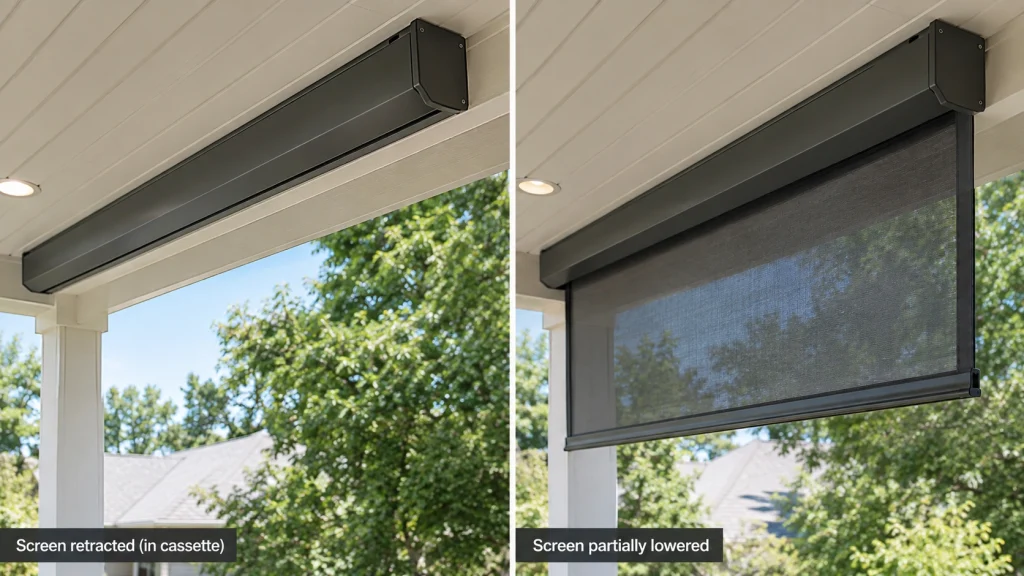
This is one of the most overlooked features, and it’s also one of the most important for longevity. When your screen retracts, where does the fabric go? On a low-quality system, it sits exposed, wrapped around an open roller bar where it takes on direct sun, pollen, humidity, and whatever else is in the air.
On a well-built system, the retracted screen fabric is fully enclosed inside a protective housing or cassette. This keeps UV rays, moisture, and debris away from the fabric when it’s not in use, which directly extends the life of the material. If you’re comparing quotes and one system has an enclosed housing while another leaves the rolled-up screen exposed, that’s a meaningful difference in how the screen will hold up over five or ten years, not just a cosmetic detail.
3. Custom-Built Sizing for Your Exact Opening
Patios, lanais, and pool enclosures rarely come in standard sizes, especially in older Lowcountry homes and custom-built properties around Charleston and Mount Pleasant. A high-quality motorized patio screen should be manufactured to fit your specific opening, not selected from a handful of pre-set width options and trimmed to fit.
This matters for two reasons. First, a custom fit means no gaps at the edges where bugs and rain can still get in, which defeats a lot of the purpose of installing a screen in the first place. Second, it means the screen can actually cover large openings. Some manufacturers can build motorized screens up to 30 feet wide, which makes a real difference for larger lanais, pool enclosures, or combined patio and outdoor kitchen spaces that a standard-size screen simply couldn’t span.
If a company can’t tell you their maximum width capability or seems vague about custom sizing, ask directly. It’s a fair question, and the answer tells you a lot about the quality tier you’re dealing with.
4. The Right Screen Type for What You Actually Need
Not every motorized screen is designed to solve the same problem, and a quality provider should walk you through the differences instead of pushing a single default option. There are generally three main types worth understanding:
- Insect screens prioritize airflow and visibility while keeping bugs out. These are the right choice if your main goal is enjoying evenings outside without mosquitoes ending things early.
- Solar screens cut down heat and UV glare while still allowing you to see through them, which helps if the biggest issue with your patio is that it becomes unusable by early afternoon.
- Privacy screens fully enclose the space, turning an open patio into something closer to a private outdoor room.
A high-quality installer will ask what’s actually bothering you about your outdoor space (bugs, heat, lack of privacy, or some combination) before recommending a screen type. If a company tries to sell you the same product regardless of what problem you’re trying to solve, that’s worth noticing.
5. Materials Engineered for Coastal Conditions
This is where a lot of lower-cost screens fall short specifically in a market like Charleston. Salt air, high humidity, and intense UV exposure are hard on outdoor materials in ways that inland climates simply don’t test for. A screen that performs fine in a dry, moderate climate can degrade much faster here.
Look for screens with fabric and hardware specifically rated for coastal or high-UV environments, not a generic all-climate product. Ask how the manufacturer addresses corrosion resistance in the motor and hardware components, since that’s often where cheaper systems fail first. A screen that’s been engineered with humidity, salt air, and storm exposure in mind should hold its color, structure, and function far longer than one that wasn’t built with those conditions as a starting point.
6. Real Warranty Coverage, Not Just a Marketing Claim
Warranty terms vary enormously between manufacturers, and the fine print matters. A genuinely strong warranty should cover the hardware, the fabric, and the motor, not just one component while leaving the others exposed to full replacement cost if something fails.
Pay attention to whether the warranty is prorated or non-prorated. A prorated warranty typically means you’ll pay an increasing percentage of the replacement cost the longer you’ve owned the product, which can leave you with a surprisingly large bill even on a “covered” repair. A non-prorated warranty means the coverage stays consistent for the full term. A 10-year non-prorated warranty that’s also transferable to a new owner if you sell your home is a strong benchmark and signals genuine confidence in the product on the manufacturer’s part.
7. An Authorized Dealer With Professional Installation and Support
The best screen system in the world won’t perform well if it’s installed incorrectly. Motorized screens involve electrical work, precise measurements, and proper mounting to structural elements, so installation quality is not a place to cut corners.
Working with an authorized dealer for a specific manufacturer generally means the installer has been trained specifically on that system, has direct access to parts and manufacturer support if something needs servicing down the road, and has some accountability tied to the brand’s reputation. This is different from a general contractor or handyman installing a screen system they’ve only worked with a handful of times. When you’re comparing providers, ask who manufactures the screen, whether the installer is an authorized dealer, and what local support looks like if you ever need a repair or adjustment after installation.
Putting It All Together
A high-quality motorized patio screen comes down to a combination of real motorized functionality, protective housing, custom sizing, the right screen type for your needs, coastal-grade materials, meaningful warranty coverage, and professional installation backed by manufacturer support. Skimping on any one of these areas tends to show up as a problem within the first few years, usually right around the time you were hoping to just enjoy the space without thinking about it.
If you’re weighing your options for a patio, lanai, or pool enclosure in the Charleston area, it’s worth having someone walk your specific space and talk through which features actually apply to your situation rather than guessing from a catalog.
Coastal Shade Pros is Charleston’s authorized SunPro dealer, and every motorized screen installation includes custom sizing up to 30 feet wide, an enclosed protective housing, your choice of insect, solar, or privacy screen fabric, smartphone and voice control compatibility, and a 10-year non-prorated warranty covering hardware, fabric, and motor.
If you’d like a free, no-pressure in-home consultation to see what a properly built system looks like for your patio, call (843) 422-3625 or request your free estimate online today.
